Stadt Nukus
Republik Karakalpakstan
329,100
Einwohner
12
Universitäten
6
Museen
4
Bibliotheken
1
Flughäfen
1
Bahnhöfe
General information about the city
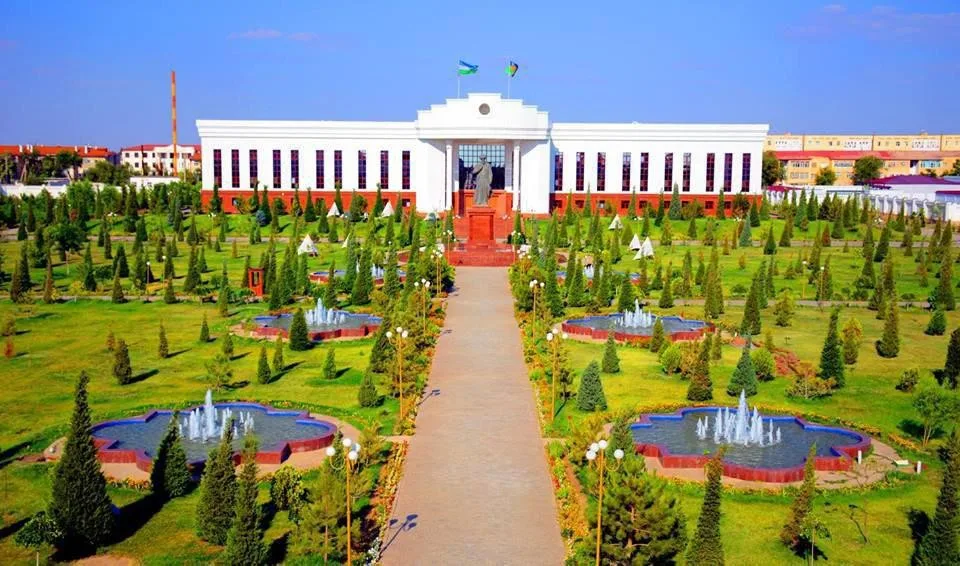
Nukus (in Karakalpak: nókis) is the capital of the Republic of Karakalpakstan. It is located in the central part of the territory of the republic, on the right bank of the Amu Darya, at an altitude of 109 m. In the south and east it is surrounded by the Kyzylkum desert, in the north it adjoins the Amu Darya delta. Scientific, cultural and political center of Karakalpakstan. Population 339.2 thousand people. The average temperature is 27° in June, -6.9° in January, maximum 46°, minimum -32°. Train Station. From Nukus to Tashkent 1265 km. The Kizketken Canal crosses the city. Covers an area of 222 km2.
History
The name Nukus comes from the old Karakalpak tribal name Nukus. Many people say that Nukus popularly means “nine people”. Nukus began to be inhabited by people in the IIIrd-IVth millennium BC. In the XIX th century, the traveler Vambury spoke about the existence of the old Nukus fortress on the banks of Karaboyly, which he saw in 1863, when he sailed from Khiva to Kungrad along the Amu Darya River. The tribes of Nukus lived in the Sarimai basin, and before they lived on the shores of the Aral Sea. According to archaeological data, this fortress was built in the form of a fortress called the Ancient Castle of Shursha. According to archaeological data, this fortress was built in the form of a fortress called the Ancient Castle of Shursha. This fortress was used as a military fortress in Khorezm for the last IV centuries. The Khorezm border and the Amu Darya river were controlled, and the Karakalpaks lived around the gorge. The building still stands. From a small village in 1932, Nukus by the 1950s had grown into a large modern city with wide avenues and large public buildings.
Population
The population is 339.2 thousand people (2024); mainly inhabited by Karakalpaks, Uzbeks, Kazakhs, Russians, Koreans, Tatars and other nationalities
Industry and transport
The city's location at the junction of major highways led to the rapid development of diversified industry. The Nukus Tashovuz and the Nukus-Guzar highway are of international importance. Navoi-Nukus railway with a length of 345 km, a bridge connecting Nukus with Khojeyli. The 243-kilometer Tuyamuyin-Nukus tunnel, the 112-kilometer Nukus tunnel, and the Takhtakupir water pumping station were built. 20% of the total industrial production of the Republic comes from industrial enterprises in the city of Nukus. There are more than 50 industrial enterprises in the city. There are branches of metallurgy, building materials, food, light, woodworking and printing industries. The industry of running materials is well developed in Nukus, there are large-panel house-building and silicate-concrete factories, building materials plants, brick and cable factories, and a Karakalpak Italian joint venture for the production of marble. There are a bakery, a meat processing plant, a vegetable canning plant, a mill and feed mills, a milk and butter plant, a wine and vodka plant, a brewery and lemonade plant, and markets. There is a medical enterprise in Nukus that collects and presses the root of a medicinal sweetener plant. The products of this enterprise are exported to the USA, Canada, Japan, as well as to European countries. Light industry enterprises include the only felt plant in Uzbekistan, a clothing and knitting factory, and a consumer services plant. The city has a printing house that prints newspapers and books in Uzbek, Karakalpak and Russian, and there is also a furniture factory. Buses run from Nukus in different directions. By air, Nukus is connected with the cities of Central Asia and Kazakhstan, European countries, with Moscow, Mineralnye Vody, Kiev, Volgograd, Baku, Astana, Kizilorda, Tashkent and all regional centers of Uzbekistan.
Culture and education
Nukus Center for Science and Culture of Karakalpakstan. In Nukus there are the Academy of Sciences of Uzbekistan, the Karakalpak branch of the Academy of Arts of Uzbekistan, branches of research institutes of skin and venereology, oncology of Uzbekistan, as well as animal husbandry, the Institute of Pedagogy, Karakalpak University, the Institute for Advanced Training of Teachers and other higher educational institutions. There are 53 secondary schools, several academic lyceums, 2 sports, 2 music schools, 18 secondary specialized educational institutions, clubs, a library, a sports complex, and a Palace of Culture. In addition to its own programs, the Nukus television studio also broadcasts television programs in Moscow, Tashkent, and Ashgabat. The city has 5 hospitals, clinics, pharmacies and consultation points, and an ambulance station. The State Musical and Drama Theater named after Berdyaev, a philharmonic society, an art museum and other museums, an amphitheater for 5 thousand spectators, a Central Stadium, 57 gyms, and a Botanical Garden are located here.
Attractions
Nukus is home to the Nukus Art Museum (also known as the State Art Museum of the Republic of Karakalpakstan named after Igor Savitsky) and the State Museum. The State Museum displays typical exhibits found through archaeological research, traditional jewelry, costumes and musical instruments, endangered or endangered flora and fauna of the area, and exhibitions on the Aral Sea issue. The art museum is famous for its collection of modern Russian and Uzbek art from 1918 to 1935. Stalin tried his best to destroy all non-Soviet art from this period and sent most of the artists to the gulag. Both Savitsky himself and the collection in Nukus have been preserved, since the city’s distance from Soviet power significantly reduced his influence. The documentary “The Desert of Forbidden Art” tells the history of this collection.
The house-museum of Amet and Aimkhan Shamuratovs in Nukus is also the center of Karakalpak musical culture. The museum collection contains the personal belongings of the Shamuratovs, including stage costumes, photographs, manuscripts, books, and letters.
Universitäten
Das Staatliche Pädagogische Institut Nukus „Azhinijaz“
Innovatsion texnologiyalar universiteti
Institut für Landwirtschaft und Agrartechnologien von Karakalpakstan
Nukus-Zweigstelle des Staatlichen Konservatoriums Usbekistans
Karakalpakischer staatliche Berdach-Universität
Samarqand davlat veterinariya meditsinasi chorvachilik va biotexnologiyalar Universiteti Nukus filiali
Nukus davlat texnika universiteti
Karakalpakstan Medical Institute
Nukus-Zweigstelle der Usbekischen Staatlichen Universität für körperkultur und sport