
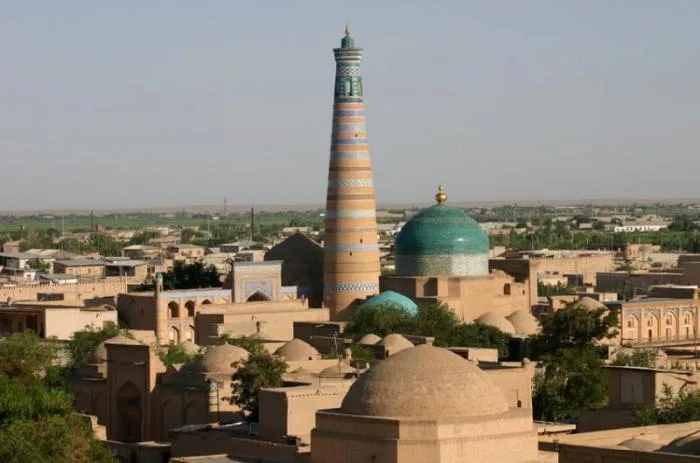
Ville de Khiva
Région du Khorezm
95,000
Population
8
Universités
5
Musées
3
Bibliothèques
0
Aéroports
1
Gares ferroviaires
The city of Khiva is one of the most populous and ancient cities in the Khorezm region of the Republic of Uzbekistan and is an unparalleled jewel of medieval Oriental architecture. It is located on a plain 25 km south of the present City of Urganch. According to the tradition, the city of Khiva was founded by Som, the son of the Prophet Nukh. Because the town was located on the caravan route, merchants often shared there.
Passengers who fell into the city and began to enjoy the obihayot coming out of its deep well were sent “he-wah " out of admiration. The local aholi, who interpreted this as their own, began by saying that the city was “Hei-wah”, “Khaiwa”, “Khivaq. One of the chroniclers of the time, Al-Istahriy (930), included Khiva in his list of the 30 largest cities of his time.
The most popular attractions are:
Visit the most sights of the city of Khiva:
The State Museum - Reserve” Ichan Fortress " is a large and unique architectural monument in Central Asia. Part of the inner fortress (Shahristan) of Khiva. Ichan fort is separated from the Dishan Fort (outer Fort) part of the city by a large wall. It looks like a high fortress from Khiva raboti (Dishan fortress). It is accessed through 4 kindergartens, a Polwon, a stone and a father's gate. The city within the walls is rectangular and covers an area of 26 hectares. The height of the walls reaches about 10 meters. The Ichan fortress Museum-Reserve has a total population of 54 historical architectural monuments and 2,600 inhabitants in 360 households. Ichan-fortress State Museum-Reserve was added to the UNESCO World Heritage List in 1990. This recognition highlights the importance and identity of this historic town. Ichan-fortress has been the center of the cultural and religious life of Khiva for many centuries, and it attracts tourists from all over the world with its architectural masterpieces and the atmosphere of the old world;
Mausoleum of Pahlavon Mahmud - The mausoleum of Pahlavon Mahmud was built mainly in the XIV century in the form of a small cave, where the body of Pahlavon Mahmud (1247-1326), the great "Piri" of his time, was buried. Pahlavon Mahmud was born in the city of Khiva in 1247 in the family of a craftsman. In his youth, his father was a leather worker, then he became literate and became a great poet and philosopher. He is a very strong wrestler, and in his 79 years of life, he never once touched the ground. Pahlavan Mahmud was an advanced and free-thinking philosopher-scientist, possessor of great talent and intelligence, and he was also called "Khayyomi of Khorezm" in terms of poetic observation. In historical sources, it is written that Amir Temur installed a door to the mausoleum. In 1701-1702, Khiva Khan Shaniyoz Khan rebuilt the mausoleum. The current mausoleum was built by Muhammad Rahim Khan I (1806-1825) after the successful campaign to Kungirot in 1810 and was completed during the reign of his son Olloquli Khan. The mausoleum consists of 3 parts. Graveyard, room and corridor. Pahlavon Mahmud himself was buried in the room located in the western part of the mausoleum. Today, this mausoleum is considered one of the most important religious and historical monuments in Ichan Castle;
Friday Mosque - Juma Mosque is located on the side of the main street that surrounds the eastern and western gates of "Ichan-Qal'a". Al-Maqsidi, an Arab traveler who came to Khorezm in the 10th century, first mentioned Khiva's Juma Mosque. However, according to the statements of Khivalik residents who have been living there for a long time, the Old Mosque was destroyed, and the present mosque was built in its place in 1788 with the same plan, which was greatly expanded. The exterior of the mosque building is very simple, its height is 4.5 meters, and the height of its minaret is 42 meters. The Juma Mosque is a one-story flat-roofed building with a total of 213 pillars. In 1983, 108 pillars of Juma Mosque were bought from the residents. Many of them were replaced with decorated columns of the XVIII-early XX centuries. In 1996-1997, Juma Mosque was renovated and brought to its present state. 15 of the ancient decorative columns have been preserved in the mosque, 8 columns are kept in the Museum of the History of the Peoples of Uzbekistan in Tashkent;
Stone Courtyard Palace - One of the famous and unique monuments in Khiva is Taskhovli Palace, which was built in 1829-1839 on the basis of the project of his minister Muhammad Ya'qub Mehtar by the order of Ollokuli Khan. This palace was built as the second Ark in Khiva, the palace of the ruler - Khan. The name of the stone yard, built of baked bricks, comes from the unique plan and architecture of the building. The stone courtyard palace consists of three large and five small courtyards, a two-story porch and rooms. First, the harem, then the hotel, and then the courtyards of the arzkhana were completed. The khan's family lived in the harem, and the hotel served distinguished guests such as foreign ambassadors, Turkmen commanders, and Karakalpak beys. In the arzkhana, the citizens' grievances were heard, and ambassadors from abroad were officially received here;
Kalta Minor - One of the most famous towers in Khiva is the unfinished Kalta minar (Blue minar). The construction of the tower was started in 1853 by Khan of Khiva Muhammad Amin Khan (next to the madrasa of the same name) and the construction work was stopped in 1855 when the Khan was killed during his march to Northern Iran and Abdullah Khan ascended the throne. There are many different legends and myths about the construction of this monument. The tower is currently in the shape of a truncated cone. Even now, it has an impressive appearance, the bottom diameter is 14.5 meters, the height is 29 meters, and the depth of the foundation is 15 meters. Based on the dynamic contraction of the tower, it is estimated that the tower would be nearly 100 meters tall when completed, making it the largest and tallest tower in the world. Currently, Kalta Minor is one of the symbols of the Ichan fortress and the city of Khiva;
Islamkhoja Tower - The minaret (of the same name) built in front of the Islam Khoja madrasa stands out for its luxury and beauty. The height of the tower is 51 meters, and according to sources, half a million bricks were used for its construction. The top of the tower is finished with an elegant cornice and domed lantern. The surface of the lantern is decorated with ceramic bricks of various shapes, and the space between them is filled with colorful glazed tiles. The tower is climbed by a spiral staircase (height 35-40 cm, 118 steps). 10 holes are made around the circle so that light falls inside. 6 latticed windows are installed in the general observation deck of the upper one. The tower is decorated with 14 tiles. A two-and-a-half-meter-high copper dome is placed on top of it, and an image of the crescent moon is placed on it, which rotates according to the movement of the wind. In 1997, this ten-piece dome was lowered to the ground, covered with gold water and repaired. The poet Niyazi wrote a historical text dedicated to the construction of the minaret, and by the order of the khan, it was written on marble and installed about ten meters above the ground;
Nurullaboy complex - distinguished from other palaces by the most luxurious, most attractive, most showy and charming. When the number of buildings in Ichan Qaleh has increased and the possibility of building new - new park–like sites has diminished, Muhammad Rahim Khan I will build his sons Mahmud Tora, Muhammad Toora, courtyard sites from the western side of the city. When Syed Muhammad Thura becomes Khan, (1856) hands over the construction of a lookout near these houses to his minister Khasanmurod Qushbegi. Bayaniy and Ogahiyalarnig wrote that this lookout, built on the day-out side of the new buildings in the park famous as” Nurullaboy", was so beautiful that he was told by the Ogahiy such a history: - "the lookout u valo" (the great lookout) from these words found the Hijri 1276 melody 1859 on the account of abjad;
Complex «Qibla new garden» - One of the most famous among Khiva palaces and mansions, it was built by Muhammad Rahim Khan (Feruz) in 1897. The palace is distinguished by its width, architectural style, variety of balconies typical of Khiva, uniqueness of construction techniques. The palace consists of three large complexes: the first courtyard is for the Khan and the people of the palace for servants, the second courtyard consists of several balconies inhabited by the Khan and his family members, and the third courtyard-a porch and rooms built in the evro-style;
House-Museum of Awareness - The Ogahi House Museum is a house-museum established in 1999 in the house of Muhammad Reza Ogahi in the Khiva city of Khorezm region. In front of the museum is a statue of the great thinker Mohammad Reza Ogahi. The house-museum of M.R. Ogahi is located on the Khiva-Koshkopir road, about 5-6 kilometers from the Old Ark. In the poet's house, "Ogahi garden" was established, where there is also a mulberry tree planted by Mohammad Reza Ogahi himself. On December 16-17, 2019, the 210th anniversary of the poet was celebrated and the Ogahi House-Museum was again restored. Currently, the house-museum is a branch of the "Ichan-Qala" state museum-reserve.
Klimat. The climate of the Khorezm region is a dry continental climate, the summer months of which can be characterized as hot and arid, and the winter months as less humid and cold. Therefore, do not forget to bring an umbrella and sunscreen when traveling to Khorezm at this time of the year.
Kitchen. The process of cooking Uzbek national dishes and food culture have a very long history and are based on the long-term experience of the people. Customs and traditions were formed based on the climatic conditions of the area and the lifestyle of the local population. Residents of each region have their own style of cooking national dishes. Khorezm region is especially famous for its dishes and its special style of cooking. Each dish has its own special taste, especially "Khorezm pilaf", "Tukhum barak", "Ushak barak", "Shivit oshi", fried fish, etc.
Gifts and souvenirs:
In the areas of the “Ichan fortress Museum Reserve” in Khiva, as well as the “Nurillaboy complex”, you can find various souvenir shops and workshops. Khiva city is one of the developed cities of the National handicraft sector of Uzbekistan. Most of the shops are located on the territory of the” Ichan fortress Museum Reserve". You can buy a number of other clothes, handmade carving products, from the famous headdress of khwarazm “chogirma”.
Universités
Mamun University

Université de technologie d’Urganch RANCH
Filiale d'Ourguentch Académie d'État de Chorégraphie d'Ouzbékistan

Université d'Innovation d'Ourguentch

Institut médical d'État d'Urgench

Al-Xorazmiy universiteti

Institut pédagogique d'État d'Ourguentch