
La ville de Samarcande
Région de Samarcande
550,800
Population
14
Universités
16
Musées
10
Bibliothèques
1
Aéroports
1
Gares ferroviaires
General information about the city
Samarkand - Crossroads of Cultures: Samarkand can be called a truly unique city!
Even if the world's greatest poets and philosophers called it the garden of the heart, the jewel of the East, the mirror of the world, and even the face of the earth, they would not have been able to describe all the beauty and wealth of this beautiful city.
Samarkand is a city located in the central part of the Zarafshan oasis with a history of 2750 years. It served as the capital for many states that existed in Movarounnahr. Its heyday in the middle ages was Amir Temur and then his grandson Mirza Ulugbek, and during the time of Muhammad Shainbani Khan, the heir of the Timurids, the city did not stop developing. Amir Shahmurad, who was from the Manghits, also carried out great creative works in the city. Since 1868, Samarkand became a dependent city of the Russian Empire. In 1938, Samarkand region was established. With the independence of 1991, Samarkand became a city of new importance.
The cultural heritage of Samarkand is enormous. For centuries, this city has been the main center of the Great Silk Road.
At the beginning of the 21st century, the city was included in the UNESCO World Heritage List under the title "Samarkand - Crossroads of Cultures"!
If you visit the city, you will be surprised by the number of historical monuments located here, but we will try to show you the most famous sights that are definitely worth seeing!
The most popular sightseeings
As of January 1, 2021, the number of architectural monuments in Uzbekistan is 2,264. Samarkand region has the largest number of architectural monuments by region, 562 monuments are registered in Samarkand.
Afrosiyab. It is located in the north of the city of Samarkand, and its area is 219 hectares. This area is the ancient place of Samarkand, which became a ruin after the invasion of the Mongols at the beginning of the 13th century. Afrosiyab's current ruling arch and city have been preserved. In the works of Eastern scholars, Afrosiyab is known by the names "Hisori kokhna" and "Kal'ai kokhna". The well-known name Afrosiyob appears in sources from the 17th-18th centuries. This name is popularly associated with the hero of the epic "Shahnoma", the legendary king of Turan, Afrosiyob (Alp Er Tonga).

In the scientific research of Afrosyab, V. L. Vyatkin at the end of the 19th - beginning of the 20th century, and later, in 1958, the activities of the Samarkand archaeological expedition became important. In particular, the history of the emergence, formation and development of the city, city fortification, stratigraphy, water supply, handicrafts, landscaping, and the city's relations with the surrounding villages will be comprehensively researched by the Samarkand archaeological expedition. In 1988, the Uzbek-French international joint expedition began working in Afrosiyab.
Shahizinda. Shahizinda is a mysterious place with a rich historical past, riddles and crafts, located in the northeast of today's Samarkand city, in the southern entrance of ancient Afrosiyob!

Shahizinda can embody the history of the greatest era of Samarkand. Because its history begins with the process of Islamization in Movarounnahr in the early Middle Ages and is connected with the Karakhanids and Seljuks who ruled in the Middle Ages, the Timurids in the advanced Middle Ages and the Mangits of the Three Khans or the New Era.
We know that Samarkand is the most noteworthy and ancient civilizational center of Movarounnahr. Shahizinda is the only historical complex that can tell about the history of Samarkand from the 7th century to the present day. The mausoleum is associated with Qusam ibn Abbas (about 624-677), the leader of Islam, the cousin of the Prophet Muhammad. He was buried in the present Shahizinda in the 7th century. In the 11th century, a mausoleum was built over his grave by the Karakhani Tavgach Bugrokhan. After that, additional construction works were carried out adjacent to the mausoleum during the Timurids (XIV-XV) and Mangits (XVIII-XIX centuries). The main buildings in the complex were erected in the form of monuments, that is, mausoleums.
In the 13th century, Ancient Samarkand - Afrosiyab was completely destroyed by Mongol invaders. The city was not restored after that, but Shahizinda, located near it, remained the only historical structure that survived the Mongol invasion. Even Genghis Khan could not touch Shahi Zinda.
At Shahizinda, the visitor has a number of options, including:
1) To see a piece of ancient Afrosiyab with one's own eyes;
2) Construction methods and styles during the Middle Ages, advanced Middle Ages and Uzbek khanates, decorative implements, symbolism, etc.;
3) to analyze the broad period of socio-cultural life in Samarkand region;
4) Today's Uzbekistan's attitude to history and historical buildings.
Hazrat Khizr Mosque - an architectural monument in Samarkand (mid-19th century); associated with the name of the legendary immortal person Hazrat Khizr. The building was built on the foundation of the ancient mosque located on the hill opposite the Shahizinda complex (1855 according to the inscription on the altar). The mosque consists of a room, 2 adjacent rooms, additional rooms, a storehouse, and a minaret; later, an additional porch (1899) and a gate house (1919) were built to the building. The gate has a dome, and two corners of the gate are decorated with dome-ribbed bouquets-towers; on the left side of the facade, the arched, carved, 5-pillared peshayvan is richly decorated with attractive patterns, and the ganch ornaments are skillfully made. From patio, it is a way to a room covered with a high dome. Outside, the dome is placed on an 8-sided plinth, decorated with muqarnas. The portal and caged minarets are decorated with tiles, arched windows are made on the portal base-dome. The building was renovated in the 90s of the 20th century. The first president of the Republic of Uzbekistan, I. Karimov, was also buried in this complex, and a magnificent mausoleum was built on the initiative of Sh. Mirziyoyev.
Gur-Amir is a shrine where the mausoleum of Amir Temur, his mentor Mir Sayyid Baraka and some members of the Timurid dynasty are buried.

Tomb of Amir Temur. It is recognized as a unique work of Central Asian architecture. The construction of the mausoleum was started in 1404 by the great Sakhibkiran Amir Temur and completed during the reign of Mirza Ulugbek. The mausoleum is located in the southwestern part of Samarkand, near the madrasa built by Mohammad Sultan, the grandson of Amir Temur, at the end of the 14th century. With the efforts of Muhammad Sultan, a madrasa and a dormitory were built near the current Amir Temur's residence. Ibn Arabshah Muhammad Sultan emphasized that he was the patron of scientists. According to orientalist V. Bartold, when Sahibkiron Amir Temur went on a military campaign in 1399, he left Muhammad Sultan in his place in Samarkand. In March 1401 he went to Damascus. After that, he took part in several battles and reached Asia Minor in 1402. But on the way back, he fell ill and died near Karahisor on March 12, 1403. In March 1404, the mother of the deceased prince, Khanzodabegim, received permission from Amir Temur to take her son's body from Sultanate to Samarkand. Later, Amir Temur, who arrived in Samarkand, ordered a new greenhouse to be built in memory of his beloved grandson. The body of the prince was brought to Samarkand and buried in the dahma behind the porch on the south side of the ensemble. After that, an octagonal building is built on the dahma.
Mironshah Mirza, Shahrukh Mirza, Sheikh Sayyid Umar, Mirza Ulugbek and Ulugbek's two children, Abdullah and Abdurahman, who died in infancy, were also buried in the mausoleum. The interior of the building was newly decorated by Ulugbek, huts were placed on the mausoleum, and an elegant marble stone was placed around it.
The mausoleum is entered through a multi-domed gallery built in 1424 on the east side. During the occupation of the Russian Empire, the gates of the mausoleum were stolen. One of the gates of Amir Temur's mausoleum is kept in London, and another one is kept in the Hermitage. The ring belonging to the owner Amir Temur is kept in the "Metropolitan" museum (New York) in America.
In 1994-1996, a large-scale repair and restoration work was carried out in the mausoleum. On June 16-24, 1941, the graves of Amir Temur and Bibikhanim were opened. In 2022, restoration work began on the mausoleum of Amir Temur.
Mirzo Ulugbek Observatory. During the years 1424-1428, a world-famous observatory was built in the north of Samarkand at the foot of the Kohak hill on the banks of the Abirakhmat stream. Prior to that, the scientific work of observing the disaster was carried out in the Ulugbek madrasa, built in 1417-1420 (in the present-day Registan square). The observatory was a three-story cylindrical building, 30 m high, with a giant quadrant with a radius of 41 m. The southern part of the square is underground, and the rest is 30 m above the ground in the northern part.

After the death of Mirzo Ulugbek, his scientific work continued for some time, and later the observatory was destroyed. It was not even possible to determine the location of the observatory. In 1908, based on the historical work "Baburnoma" by Babur Mirza and "Samaria" by Abu Tahirkhoja, as well as the information in the foundation document, in cooperation with Samarkand scholar Abu Sa'id Mahzum, a local scholar and archaeologist V. L. Vyatkin (popularly known as Vosi aka) agreed to determine the location of the observatory. Excavations were carried out in 1908-1909, which attracted the attention of scientists from all over the world. Two parallel arcs made of marble, a fragment of a very large square (device) with a meridian radius of 41 m were found in the cave carved into the rock. In 1946-1948, the expedition of the Institute of History and Archeology of the Academy of Sciences of Uzbekistan completed the excavation work. The observatory was built in 1424-1428. Abu Takhir Khoja's book "Samaria" also provides accurate information.
At the observatory, it was possible to conduct some observations with the naked eye, that is, without instruments. The diameter of the observatory square is 80 meters, and the length of its arc is 63 meters. It was the largest of the existing instruments in the East, Beruni also reported that it had a large diameter quadrant (15 cubits). Famous scientists of their time - astronomers, mathematicians, architects, including Qazizada Rumi, Ghiyosiddin Jamshid and Ali Kushchilar - were involved in the construction. After the death of Mirzo Ulugbek, the observatory operated for several decades under the leadership of Muhammad Ali Kushchi and Miram Chalabi.
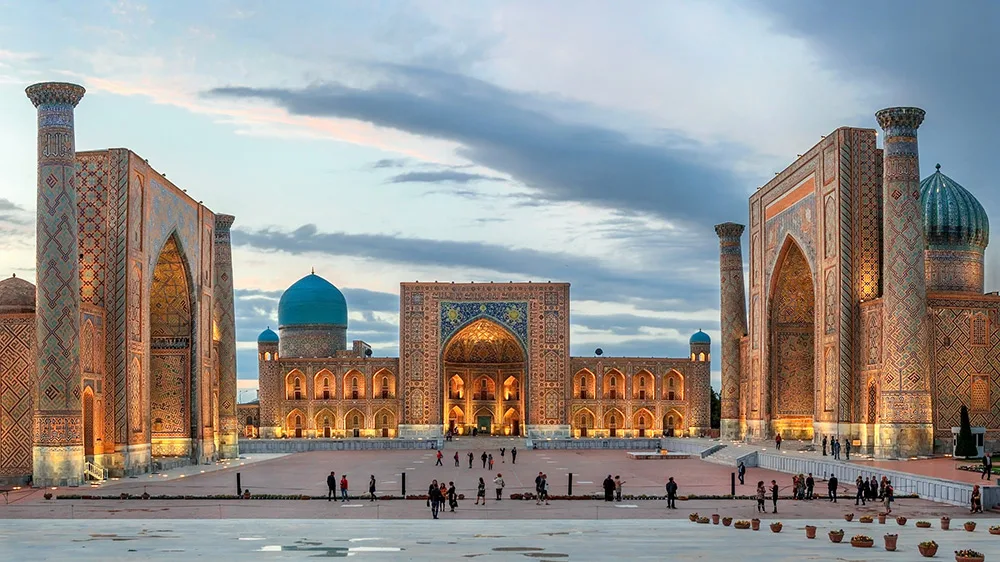
Registan square. Registan is the main square of the city of Samarkand and the most famous attraction. There are three famous madrasas in it - Ulugbek, Sherdar and Tilla-Kori.
The unique visiting card of Samarkand, the capital of twenty-seven countries united by Amir Temur. The word "Registan" is derived from the Persian language and means "sandy place", i.e. "reg" means sand, "istan" means standing place. According to historical data, a large stream flowed here from the south-east to the north-west, and after time the stream dried up, a sandy place remained and the word "Registan" was born.
P.S. Do not forget that when visiting the religious attractions of Uzbekistan, women are advised to cover the exposed parts of the body (shoulders, waist and legs), the attractions are marked with signs.
Photos de la ville
Universités

Université Médicale d'État de Samarcande
Université d'État de Samarkand nommée en l'honneur de Charof Rachidov

Samarqand xalqaro texnologiya universiteti

Samarqand state pedagogical institute

Institut d'État des langues étrangères de Samarkand

Université technique d'État de Samarcande

Samarkand Institute of Economics and Service

Université d’État de Médecine Vétérinaire, d’Élevage et de Biotechnologie de Samarcande

Institut pédagogique d'État de Kattakourgan
Silk Road International University of Tourism and Cultural Heritage