
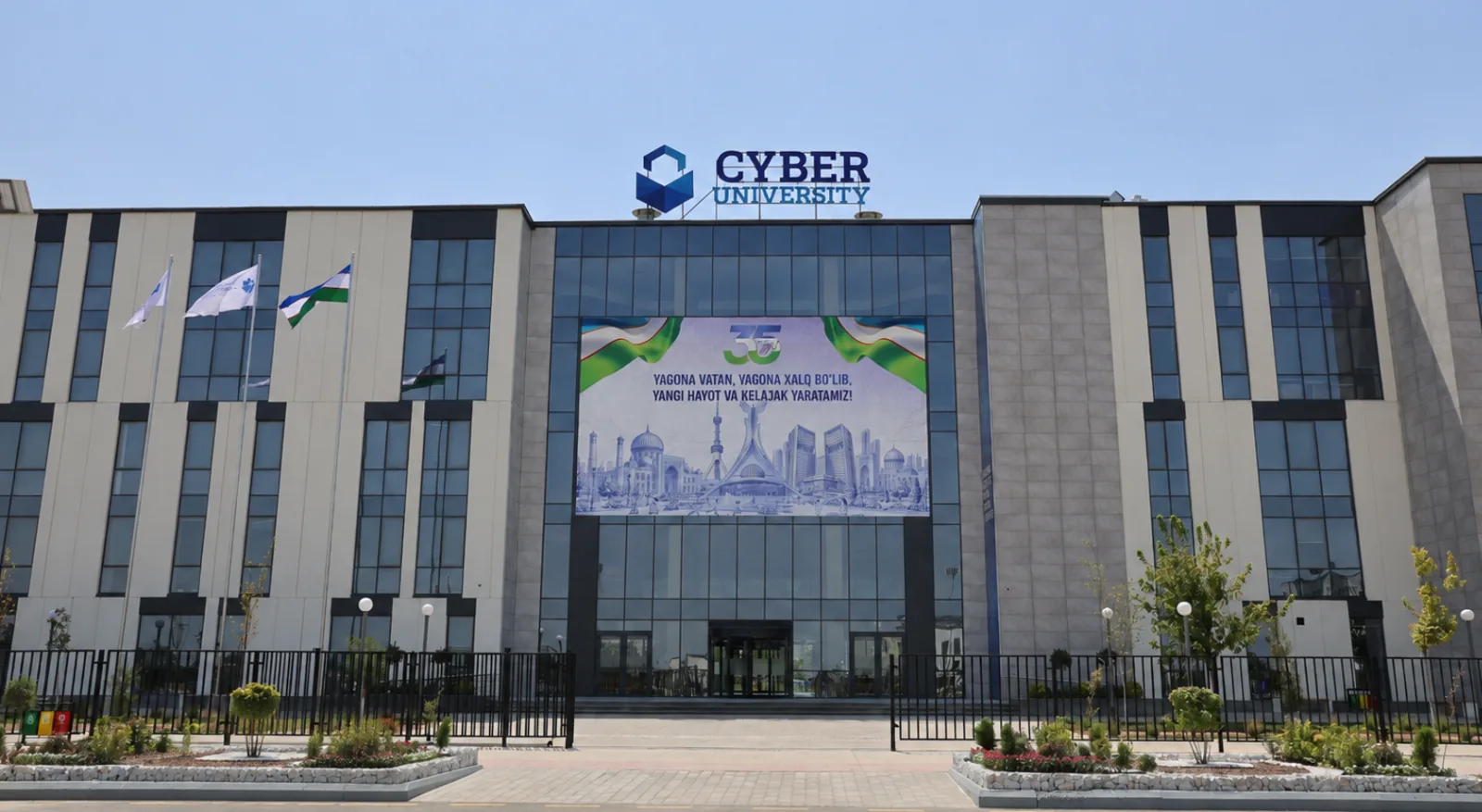
“Cyber University” State University
971
Students
0
International students
40
Teaching staff
2
Faculties
4
Departments
2025
Founded
Video and photos
About the university
Cyber University is a modern public higher education institution specializing in the education and training of highly qualified professionals in the fields of cybersecurity, artificial intelligence, digital technologies, and the digital economy. The University has identified the integration of education, research, and innovation, the promotion of international academic cooperation, and the development of graduates with practical competencies aligned with the needs of government institutions and the private sector as its strategic priorities. In addition, the University aims to contribute to the country's digital transformation by leveraging state-of-the-art laboratories, advanced educational technologies, and international best practices. Cyber University was established pursuant to Presidential Resolution No. PQ-14 of the President of the Republic of Uzbekistan, dated 20 January 2025.
For international students
The University is currently establishing all the necessary academic, administrative, and support arrangements to facilitate their successful enrollment and integration. Including, but not limited to
Registration and Local Formalities: Upon your arrival in Uzbekistan, the University Administration and the Department of International Cooperation will provide practical assistance with migration registration, the completion of required documentation, and adapting to local administrative procedures, ensuring a smooth transition to student life.


Guaranteed Accommodation: International students are guaranteed a place in the University's student residence halls. The University Administration and the Department of International Cooperation will support you throughout the accommodation process, including room allocation, application procedures, and all residence-related arrangements.

Adapting to a New Environment: Adjusting to a new country, culture, and education system naturally takes time. To help you settle in, the University offers orientation programmes, adaptation activities, experienced student advisors, and opportunities to engage with both local and international students, making your transition easier and helping you feel at home from the very beginning.

Hands-on Practical Experience: The University places strong emphasis on combining academic knowledge with practical application. Throughout your studies, you will have opportunities to undertake internships with local and international companies, participate in industry-driven projects, and gain the real-world experience needed for a successful professional career.

International Certifications and Learning from Industry Experts: During your studies, you will have the opportunity to earn internationally recognised professional certifications in your field. You will also learn from leading local and international experts through specialised workshops, masterclasses, and training programmes in cybersecurity, artificial intelligence, and other advanced information technologies, enabling you to develop skills that meet international standards.

IT and Intellectual Development: The University regularly organises programming, cybersecurity (CTF), robotics, and artificial intelligence competitions that allow you to apply your theoretical knowledge in practice, gain valuable hands-on experience, showcase your talents, and further develop your technical and problem-solving skills.

International partnerships
International cooperation is one of Cyber University's key strategic priorities. It serves as a cornerstone of the University's efforts to integrate into the global academic community, foster a modern educational and research environment, and incorporate international best practices into education, research, and applied innovation.
Cyber University aspires to become an internationally recognized university and center of excellence in cybersecurity, information security, software engineering, digital law, digital technologies, artificial intelligence, and the digital economy.

The University's international engagement is designed to support this vision by establishing sustainable partnerships, participating in transnational initiatives, and progressively integrating international best practices into its academic and research activities.
 Cyber University's international cooperation activities are guided by the following objectives:
- enhance the quality of education and research through international expertise, modern methodologies, and advanced educational resources;
- educate a new generation of innovative professionals who are globally competitive and prepared for academic mobility;
- strengthen the University's international academic partnerships;
- increase the University's visibility and reputation in international academic and subject-specific rankings;
- contribute to the development of national and global digital ecosystems through education, research, and innovation.
 Cyber University is committed to expanding its international engagement through a wide range of collaborative initiatives, including:
- establishing partnerships with leading international universities, research institutions, and technology companies;
- signing memoranda of understanding and institutional cooperation agreements;
- developing joint educational initiatives and academic programmes;
- expanding academic cooperation with foreign higher education institutions through thematic schools, professional training programmes, study visits, and exchange initiatives;
- implementing joint research projects and participating in international research consortia;
- participating in international grant programmes and funding initiatives;
- organizing international conferences, forums, seminars, workshops, and hackathons to promote scientific dialogue and knowledge exchange;
- developing global alumni networks that contribute to the advancement of digital technologies and professional collaboration.

Cyber University's international cooperation currently spans the United States, China, Japan, the Republic of Korea, and Poland.
To date, the University has signed 17 cooperation memoranda, including nine agreements with international universities and academic institutions.
These partnerships include:
- United States: University of Washington, University of North Georgia;
- China: Xidian University, University of Electronic Science and Technology of China;
- Japan: Teikyo University;
- Republic of Korea: Konkuk University;
- Poland: Poznań University of Technology and Silesian University of Technology.
 In addition to academic institutions, the University actively collaborates with industry partners, professional academies, research organizations, and public-sector institutions. Notable partners include the Academy of Law Enforcement, Unicon.Uz, Uztelecom, Latmedia Group, BIT Computer, Check Point, Group-IB, Mondrian AI, and Beeline.
Cyber University is continuously strengthening its integration into international academic and professional networks. The University is currently a member of five international academies and consortia:
- Cybersecurity Clinics Consortium;
- Cisco Academy;
- Check Point Secure Academy;
- Huawei ICT Academy;
- CompTIA.
Participation in these international platforms enables the University to adopt global best practices, expand opportunities for students and faculty members, strengthen practical skills development, and further integrate into the global professional community in cybersecurity and digital technologies.
For Cyber University, international cooperation extends far beyond building external partnerships. It is a strategic instrument for enhancing educational quality, strengthening research excellence, fostering innovation, and preparing globally competitive professionals capable of leading the digital transformation of society.
Language courses
The language of instruction at the University is provided in Uzbek and Russian during the first year of study. Starting from the second year of study, students receive the instruction in English.
Faculties
The Faculty of Law and Business is the university's specialized academic division dedicated to training highly qualified professionals in the context of the rapidly evolving digital economy, modern governance, and legal systems. The faculty's primary goal is to prepare specialists who possess deep expertise in economics, business, and law, while also being able to effectively apply the capabilities of cybersecurity, digital transformation, and modern information technologies in their professional practice.
Throughout the educational process, the faculty integrates digital technologies and cybersecurity across all academic programs. In addition to traditional professional knowledge, students acquire competencies in cutting-edge areas such as the digital economy, e-government, data analysis, artificial intelligence, personal data protection, cyber law, information security management, and digital risk assessment. This approach enables graduates to actively contribute to the digital transformation processes taking place in both the public and private sectors.
The faculty offers three academic programs. The Jurisprudence program covers cyber law, digital forensics, personal data protection, electronic contracts, and the legal frameworks for combating international cybercrime. The Economics program places particular emphasis on the digital economy, fintech, economic analysis, data-driven decision-making, and the economic dimensions of cybersecurity. The Management program builds contemporary knowledge in digital transformation, innovation management, cybersecurity risk management, corporate governance, and strategic decision-making.
Teaching at the faculty is organized around applied projects, seminars involving business representatives, government bodies, and international partners, as well as case studies aimed at solving real business challenges. As a result, graduates enter the labor market as competitive professionals who are aligned with the demands of the digital age and who recognize cybersecurity as a priority discipline across law, economics, and management.
The Faculty of Engineering is the university's leading academic division, specializing in training highly qualified professionals in the fields of digital technologies, modern engineering solutions, and cybersecurity. The faculty's primary goal is to prepare engineers with deep theoretical knowledge and practical skills in designing, developing, managing, and ensuring the cybersecurity of modern information systems.
At the heart of the faculty's activities lie the principles of cybersecurity. Special emphasis is placed on the creation of digital infrastructures, software products, and computer systems within existing academic programs — covering information security, secure programming, network protection, security testing, and threat management.
The faculty encompasses three modern academic programs. The Cybersecurity Engineering program trains specialists in building systems protected against cyberattacks, security architecture, and the protection of digital infrastructure. The Software Engineering program cultivates modern developers grounded in secure software development, artificial intelligence, cloud technologies. The Computer Engineering program focuses on computer architecture, IoT, embedded systems, networks, and the design of hardware-software complexes along with ensuring their cybersecurity.
Education at the faculty is integrated with state-of-the-art laboratories, applied projects involving industry partners, international certification programs, and research activities. Graduates are fully equipped to pursue successful careers in the public and private sectors, banking and finance, telecommunications, defense, industry, and international IT companies — as cybersecurity engineers, software engineers, systems architects, network engineers, and information security specialists.
Fields of study
| Computer Engineering (Design of Computer Systems, Design of Practical Software, Information and Multimedia Technologies) 60610300 | Bachelor |
| Cyber law 70420131 | Master's |
| Cyber security engineering 60612100 | Bachelor |
| Economy 60410100 | Bachelor |
| Information security (by areas) 70610302 | Master's |
| Jurisprudence 60420100 | Bachelor |
| Jurisprudence (by types of activity) 60420100 | Bachelor |
| Management. 60410800 | Bachelor |
| Software engineering 60610400 | Bachelor |
Programmes
All programmes →
“Cyber University” State University
Cyber law
36 025 720 so'm
per year
“Cyber University” State University
Jurisprudence (by types of activity)
34 823 896 so'm
per year
“Cyber University” State University
Cyber security engineering
30 020 600 so'm
per year
“Cyber University” State University
Information security (by areas)
32 422 248 so'm
per year
“Cyber University” State University
Economy
32 422 248 so'm
per year
“Cyber University” State University
Management.
32 422 248 so'm
per year
“Cyber University” State University
Jurisprudence (by types of activity)
34 823 896 so'm
per year
“Cyber University” State University
Software engineering
30 020 600 so'm
per year
“Cyber University” State University
Computer Engineering (Design of Computer Systems, Design of Practical Software, Information and Multimedia Technologies)
30 020 600 so'm
per year
“Cyber University” State University
Cyber security engineering
30 020 600 so'm
per year
Notable alumni

Juraev Isfandiyor

Rahmatullayeva Sabina